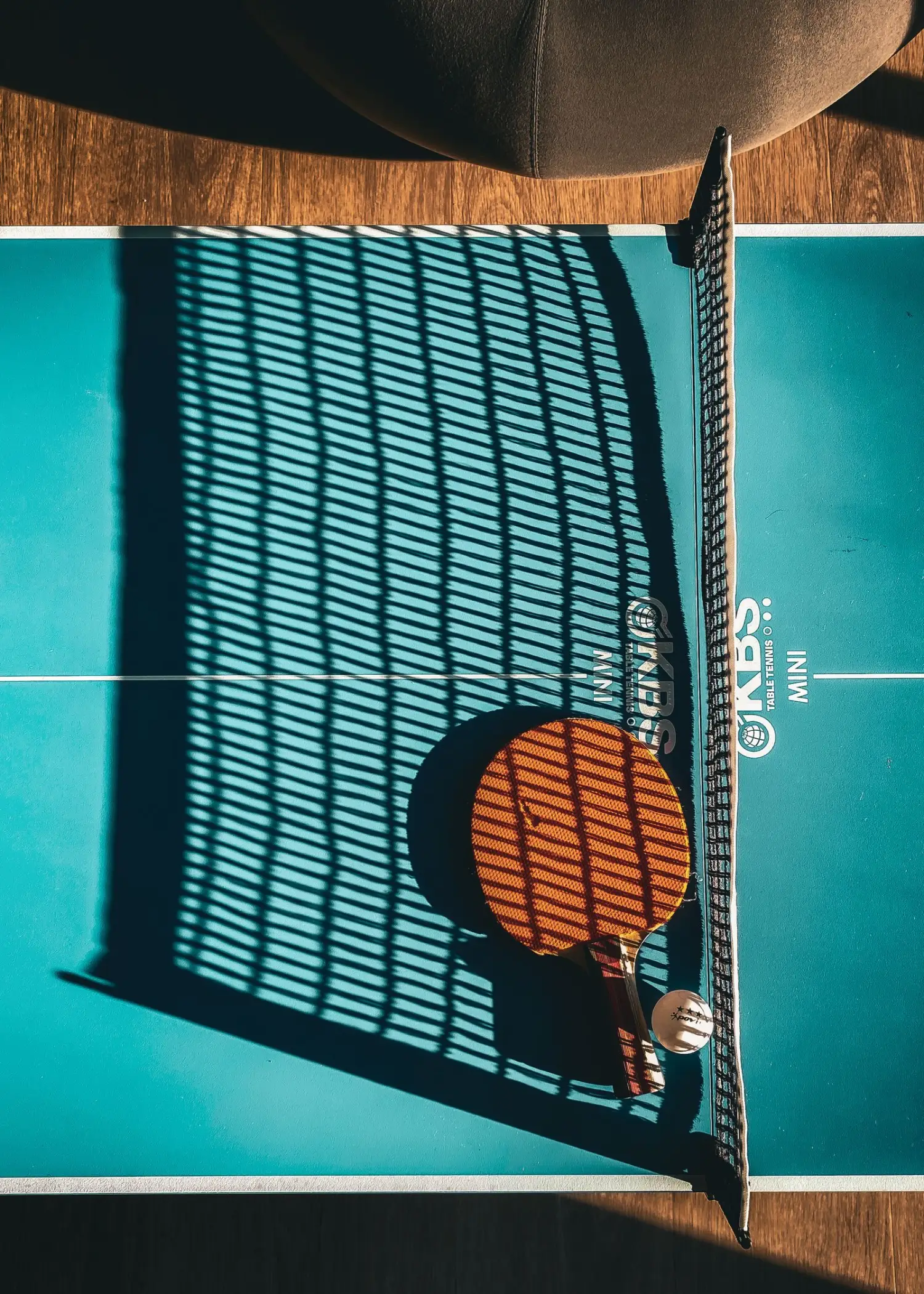
Table tennis scoring is simple once you know the handful of rules that matter: games to 11, win by two, and a match made of an odd number of games. This guide covers how a game and a match are won, how serving works, and the rules that most often catch people out.
These follow the international (ITTF) rules used at clubs and tournaments. Casual house rules vary, but if you are running an event, these are the ones to use.
Winning a game and a match
A game is first to 11 points, and you must win by two. If the score reaches 10-10, play continues until one player leads by two, so a game can finish 12-10, 13-11, and so on.
A match is the best of an odd number of games. Best of five means first to three games wins; best of seven means first to four. Club nights often use best of five, and finals sometimes go to best of seven.
- Every rally scores a point, whoever served. This is 'rally scoring', and it is why games move quickly.
- Players change ends after each game. In the deciding game they switch again when one player first reaches 5 points.
How serving works
Serve alternates every two points: you serve twice, then your opponent serves twice, and so on. At 10-10 (deuce), serve changes every single point until the game is decided.
A legal serve starts with the ball resting on your open, flat palm, behind the end line. You toss it straight up at least 16 cm, roughly the height of the net, without spin, then strike it so it bounces once on your side and then once on your opponent's side.
- In singles the serve can land anywhere on the opponent's half. There is no diagonal rule, unlike tennis.
- A 'let' is called if the ball clips the net on the way over but still lands legally. The serve is simply replayed, with no point lost and no limit on how many times.
What counts in a rally
After a legal serve, players take turns hitting the ball back over the net. A point ends the moment someone fails to make a good return.
- The ball must bounce once on your side before you hit it back. You cannot volley it out of the air, unlike tennis.
- A ball that clips the edge of the playing surface is in. One that hits the vertical side of the table is out.
- You lose the point if you miss the ball, send it off the table or into the net, or if your free hand touches the playing surface.
- If the ball strikes your paddle hand below the wrist, it counts as hitting the racket and play continues.
Doubles rules
Doubles adds two rules to the singles game: partners must alternate shots, and the serve is diagonal.
- Partners take turns hitting. You cannot play two balls in a row, even to save a point.
- The serve goes from the server's right half-court, diagonally, to the receiver's right half-court (the centre line counts as part of the right half).
- The serving and receiving order rotates each game and at every change of serve, so everyone plays everyone over the match.
Rules people get wrong
- Win by two: 11-10 is not a win. You need a two-point lead.
- Serve changes every two points, not every point, until the score reaches 10-10.
- The old 21-point scoring is gone. Games have been to 11 with rally scoring since 2001.
- Singles serves can go anywhere. Only doubles serves have to be diagonal.
Common questions
How many points win a game of table tennis?
11 points, and you have to win by two. At 10-10 the game continues until someone leads by two, so a game can finish 12-10, 13-11, and so on.
Is table tennis best of 5 or best of 7?
Both are used. Best of five (first to three games) is common for club matches; best of seven (first to four) is often used for finals and higher-level play. Decide which before the event and apply it to everyone.
How often does the serve change?
Every two points: each player serves twice in turn. Once the score reaches 10-10, the serve changes every single point until the game is won by two.
Does the serve have to be diagonal in table tennis?
Only in doubles, where the serve goes from the server's right half-court to the receiver's right half-court. In singles the serve can land anywhere on the opponent's side.
What is a let in table tennis?
If the ball touches the net during a serve but still lands legally on the other side, it is a 'let' and the serve is replayed, with no point awarded. There is no limit on the number of lets.