A giant round robin is a two-stage club night. Everyone first plays a round-robin pool stage in groups. Then, instead of one final for the few best players, each of the top four places gets its own final: group winners play Final A, runners-up Final B, third places Final C and fourth places Final D.
This guide explains how the tiers work, how many matches a night takes, and when to use it. In PingPong Arena this format is called "Big Field". It is included on the Club plan for events of up to 16 players; the last part covers how to run it and what to do with a bigger field.
How does a giant round robin work?
Stage one is a normal group stage: the players are split into groups and everyone in a group plays everyone else in it. Stage two sorts the players into tiers by their exact place in their group.
- Final A: every group winner.
- Final B: every runner-up.
- Final C: every third place.
- Final D: every fourth place. Players who finish 5th or lower in their group do not play a final.
- Each tier can be played as a knockout bracket or as a new round-robin pool.
How many matches does a giant round robin take?
Take 16 players in four groups of four. The pool stage is 4 × 6 = 24 matches, three for each player. Each tier then has four players: a knockout tier needs at least 3 matches (two semi-finals and a final), and a round-robin tier is 6 matches.
So the whole night is roughly 36 matches with knockout tiers, or 48 with round-robin tiers. With 12 players in three groups of four, the pool stage is 18 matches and each tier has three players.
- A round robin of n players is n × (n − 1) ÷ 2 matches: 4 players play 6, 16 players would play 120.
- Splitting 16 players into groups first is what keeps the night to one evening instead of 120 matches.
When should you use a giant round robin?
Use a giant round robin when your field is mixed and you want everyone to play meaningful matches late into the night. In a classic groups-then-knockout night, most players are finished after the group stage. Here, fourth places play fourth places, so the finals are close matches at every level.
It needs more matches than a classic night, so it works best with several tables. If you are short on tables or time, a classic groups night with one knockout final is quicker.
Plan limits: up to 16 players on Club
There are at most four tiers, Final A to Final D, one per finishing place. More groups make each tier bigger; they do not add tiers.
- Free plan: Big Field (either Giant RR variation) is not available. Free includes Simple, Groups and Ladder.
- Club plan: Big Field is included for events of 16 players or fewer. Above 16, the app blocks the start and shows a message.
- Club Pro, which removes that limit, is not available to buy yet.
- More than 16 players: use the regular Groups format instead. It allows up to 32 players per event on Club (16 on Free) and finishes with one knockout bracket.
Run a giant round robin in PingPong Arena
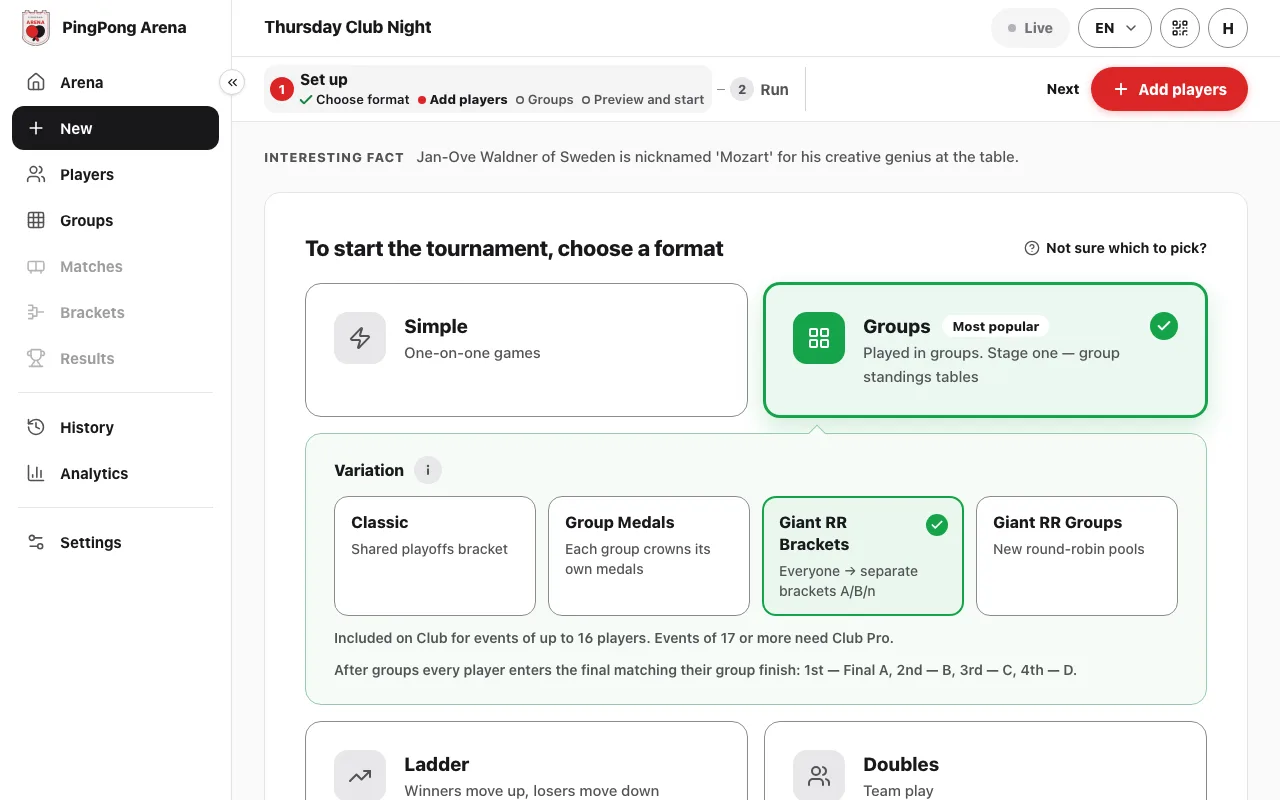
Open Arena and choose Groups. Under Variation, pick one of the two Big Field options (Giant RR is the app's short name for Giant Round Robin):
- Giant RR Brackets: each tier is a knockout.
- Giant RR Groups: each tier is a new round-robin pool.
- Then follow the steps bar: "Add players", "Groups" (Auto or Custom, with snake seeding) and "Preview and start", where you tap "Start tournament". The app draws the groups now and the tiers when the pool stage ends.
During the night: from pools to tiers
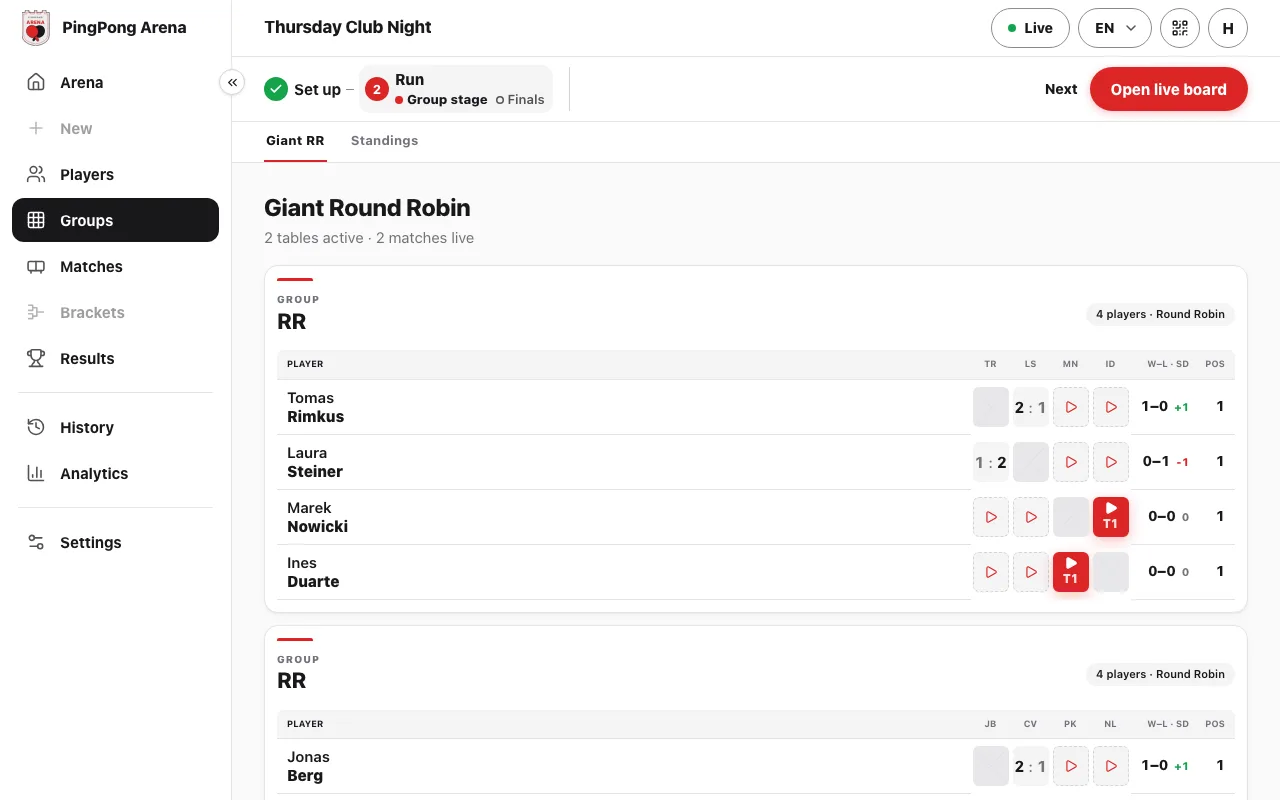
During the pool stage, the group tables fill in as results arrive. Tap a match to type in the sets or open the live board to score point by point; a finished result can be corrected from the same cell.
Once the pool stage is over, the app draws Final A to Final D from the group finishes, so you never sort the tiers by hand.
See the results
During the pool stage, "Results" and the "Standings" tab rank everyone by match wins, marked "in progress" until the tournament is over. Once the tiers are drawn, "Brackets" opens Final A; Final B, Final C and Final D are the tabs beside it.
Inside a group, players with the same number of wins are ranked by the matches between them (wins, then sets ratio, then points ratio in those matches), then by set difference and point difference across the group. Official events start the same way: under ITTF Regulation 3.7.5.2, tied group members are ranked only by the results of the matches between them, considering match points, then the ratio of games won to lost, then the ratio of points won to lost.
"End & archive" saves the night to History, where the "Report" button builds a summary you can share.
ITTF Statutes 2026: Regulation 3.7.5, group rankings and ties (PDF) →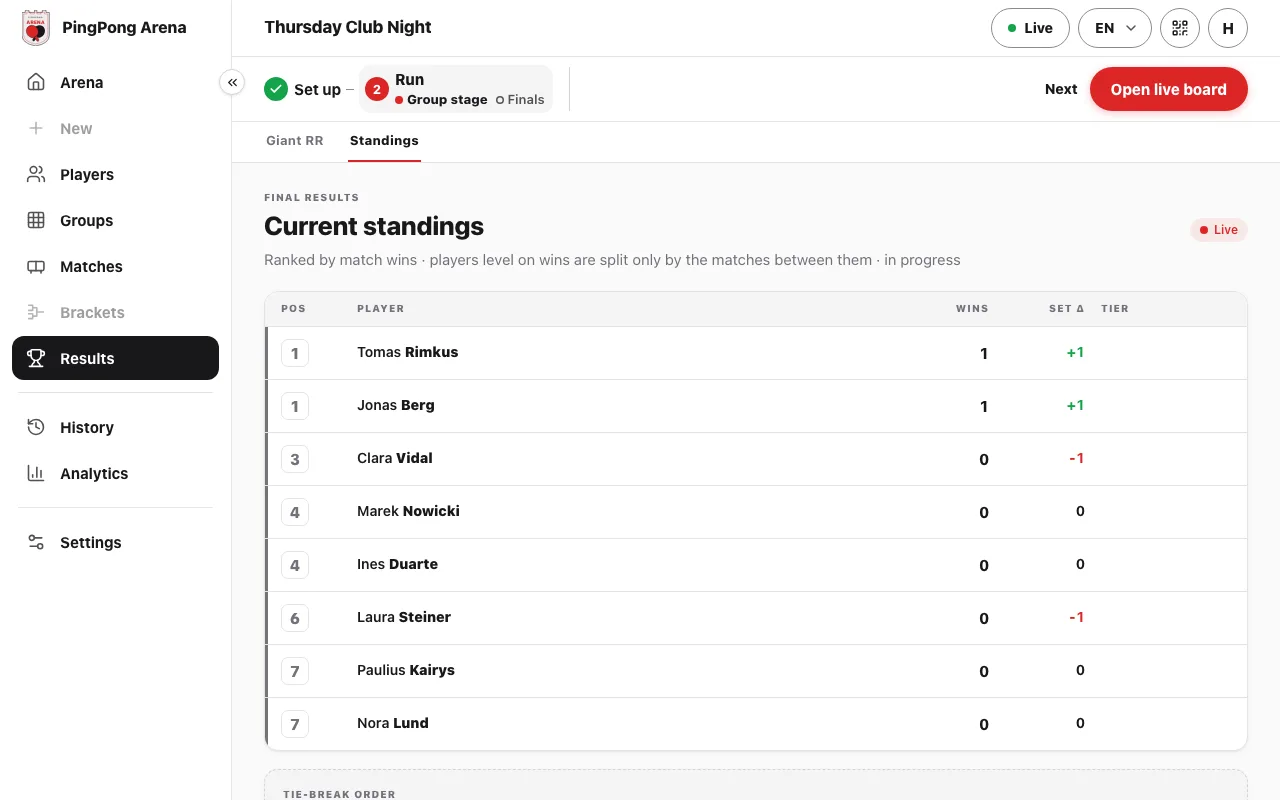
Common questions
What is a giant round robin in table tennis?
A two-stage format: a round-robin pool stage in groups, then tier finals by finishing place. Group winners meet in Final A, runners-up in Final B, third places in Final C and fourth places in Final D.
How many players can play a giant round robin in PingPong Arena?
Up to 16 players per event on the Club plan. Club Pro, which removes that limit, is not available to buy yet, and the format is not on the Free plan.
How do I run a round robin table tennis night for more than 16 players?
Use the regular Groups format: everyone plays round-robin groups, then the top players go into one knockout bracket. Groups allows up to 32 players per event on Club and 16 on Free.
What's the difference between Giant RR Brackets and Giant RR Groups?
Both put players into tiers by their exact pool-stage finish. Giant RR Brackets runs each tier as a knockout; Giant RR Groups runs each tier as a new round-robin pool, which takes more matches.
Can I change the variation after the tournament starts?
No. The variation is fixed once matches exist, the same as the overall format. Decide before you start, not mid-event.